ARTIFICIAL INTELLIGENCE
ARTIFICIAL INTELLIGENCE
In this article, we are
going to learn about the introductory part of
Artificial Intelligence. It's reason for the
development and the reason for its increasing use in the
computer world.
- Thinking Humanly
- Acting Humanly
Objective: Artificial Intelligence is a major step forward in how computer system adapts, evolves and learns. It has widespread application in almost every industry and is considered to be a big technological shift, similar in scale to past events such as the industrial revolution, the computer age, and the smart phone revolution.

- Chatbots use AI to understand customer problems faster and provide more efficient answers
- Intelligent assistants use AI to parse critical information from large free-text datasets to improve scheduling
- Recommendation engines can provide automated recommendations for TV shows based on users’ viewing habits.
Artificial intelligence is a branch of computer science which deals with making a computer system to learn and act humanly. The main objectives of artificial intelligence are to as follows:
ARTIFICIAL INTELLIGENCE:- In the simplest terms, AI which stands for artificial intelligence refers to systems or machines that mimic human intelligence to perform tasks and can iteratively improve themselves based on the information they collect. AI manifests in a number of forms. A few examples are:
AI is much more about the process and the capability for superpowered thinking and data analysis than it is about any particular format or function. Although AI brings up images of high-functioning, human-like robots taking over the world, AI isn’t intended to replace humans. It’s intended to significantly enhance human capabilities and contributions. That makes it a very valuable business asset.
UNIT - I
CONCEPT OF
AI:- Artificial
Intelligence is composed of two
words Artificial and Intelligence,
where Artificial defines "man-made," and
intelligence defines "thinking
power",
hence AI means "a
man-made thinking power."
Here’s a brief timeline of the past six decades of how AI evolved from its inception.
1956 - John McCarthy coined the term ‘artificial intelligence’ and had the first AI conference.
1969 - Shakey was the first general-purpose mobile robot built. It is now able to do things with a purpose vs. just a list of instructions.
1997 - Supercomputer ‘Deep Blue’ was designed, and it defeated the world champion chess player in a match. It was a massive milestone by IBM to create this large computer.
2002 - The first commercially successful robotic vacuum cleaner was created.
2005 - 2019 - Today, we have speech recognition, robotic process automation (RPA), a dancing robot, smart homes, and other innovations make their debut.
2020 - Baidu releases the LinearFold AI algorithm to medical and scientific and medical teams developing a vaccine during the early stages of the SARS-CoV-2 (COVID-19) pandemic. The algorithm can predict the RNA sequence of the virus in only 27 seconds, which is 120 times faster than other methods.
How an Intelligent system works?
A System, which in terms of Artificial Intelligence is termed as an agent has to work in accordance with its surroundings and conditions. The system is responsible for perceiving information from its surroundings and causing any changes in the environment.
- Agent
- Environment
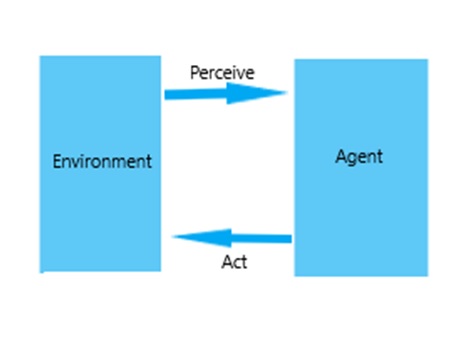
Artificial intelligence studies the whole system by dividing it into two components:
An agent can either perceive some information from the environment or can perform some actions on the environment.
Agent: The system which is responsible for acting on the environment and causing any changes to it is called an agent. It first perceives the information by observing the environment and then acts according to the particular scenario. An agent is the one which should be designed in such a way that it may interact from its surroundings by itself, i.e. it should not require any user input to feed information into it. It should be able to understand the situation, find the best decision that could be taken, and then act according to it.
Environment: Everything which surrounds the agent is the environment for the agent. It can also be defined as anything present in the universe except the agent through which the agent can perceive information and can act on it is the environment. It should be noted that every part of the environment may not be in the reach of the agent i.e. the agent may not be able to observe or access some parts of the environment, so any changes happening in that area will not be the concern of our agent.
In next we will learn Agents , Click here .
Comments
Post a Comment